Modelling a small centrifugal pump that someone else could print
Case study — modelled from scratch, prototyped
A customer came looking for a small centrifugal pump they could produce on their own printer. There was no file and no existing part to copy, so the pump was modelled from scratch and prototyped, with printability on a home machine treated as a design constraint rather than an afterthought.
The job in short
- ARRIVED ASA description of the problem — no file, no part
- WORK3D modelling and prototyping
- CONSTRAINTHad to print on the customer's own machine
- OUTPUTA modelled, prototyped pump assembly
Every detail on this page came from the job itself. Nothing here is inferred from the photograph.
A job that started with nothing
Most enquiries arrive with something attached: a file, a drawing, a photograph, a broken original. This one arrived with none of those. The customer wanted a small centrifugal pump and wanted to be able to print it themselves, and that was the whole brief. There was nothing to measure and nothing to convert — the pump had to be designed before anything could be printed.
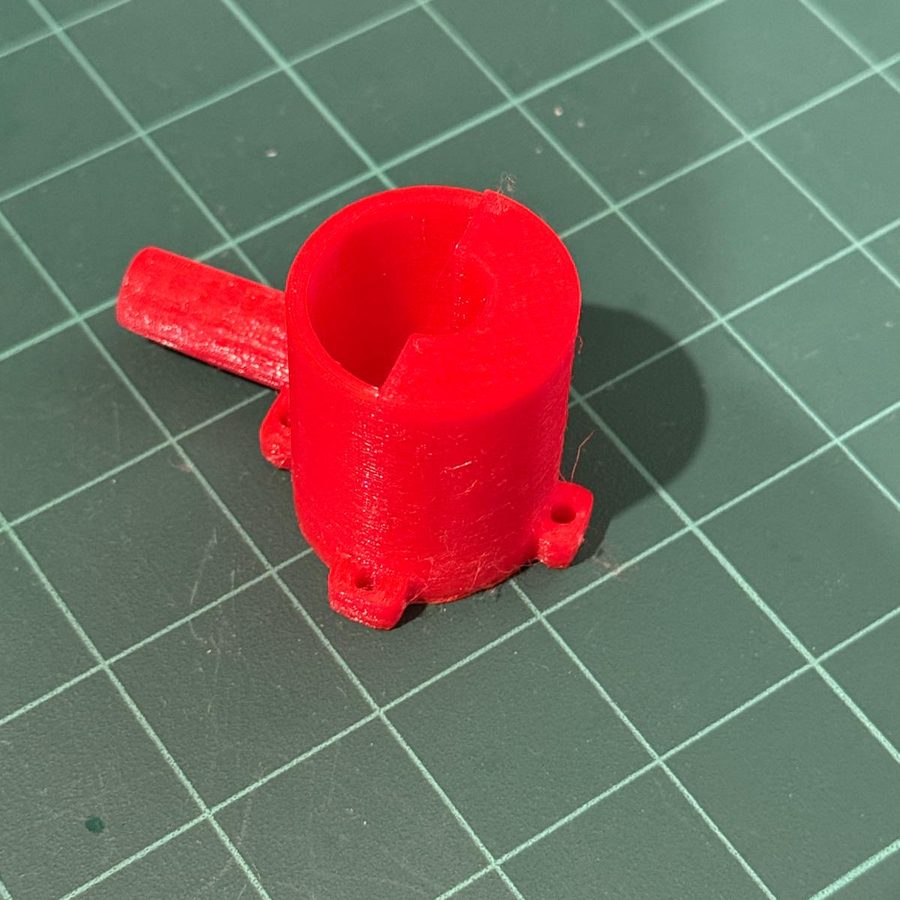
That makes this the purest modelling job of the six shown on this site, and the one that shows most clearly what the design side of the work actually is. The photograph is the prototype housing: a cylindrical body with a side outlet and two flanged feet. The rest of the assembly was modelled alongside it.
Designing for somebody else's printer
The unusual constraint here was that the finished design would not be printed here. It had to run on the customer's machine, which meant every choice had to survive leaving the workshop.
In practice that shapes the geometry throughout. Overhangs have to stay within what prints cleanly without heroic support, because supports that need careful removal are exactly what goes wrong in someone else's hands. Parts have to sit on the bed in an orientation that is obvious rather than one that needs explaining. Wall thicknesses have to suit a common nozzle rather than a fine one. Anything that only works if the printer is well tuned is a bad decision, because the whole point is that the design keeps working when it is handed over.
Designing a part to be manufactured on equipment you do not control is a different discipline from designing one you will make yourself. It is closer to product design than to job-shop work, and it is genuinely more constrained.
What a printed pump can and cannot do
This is the honest-limits section, and on a pump it matters more than usual.
An FDM part is built from stacked extrusions, and the interfaces between those extrusions are the weak point. A printed housing is not watertight by default — liquid finds the layer lines. Getting a printed pump to hold a liquid properly is a matter of wall thickness, print settings and, realistically, sealing the part afterwards or designing for a gasket and a seal you buy rather than one you print.
The other limits are the ones that apply to everything made here. Nothing printed in PLA, PETG or TPU should be run near heat. Nothing printed here is suitable for drinking water or for anything that goes into a body. A printed pump is a working device for low-pressure, low-duty, non-critical use — a project, a rig, a demonstration, a piece of equipment where a failure means a puddle and not an injury. Anything beyond that wants a manufactured pump, and it is cheaper to be told so at the enquiry than to find out later.
What this job shows
That a job can start from a sentence. If you can describe what you need something to do, that is enough to begin — a file is convenient, but it has never been the entry requirement. And when the design is the deliverable, the design has to account for who will be making it, not just for what it has to do.
Got a part like this one?
Send a photo of the part, drawing or assembly with a rough size, and tell us the machine or assembly it's for. Minimum order $75.
Email a photo for a quoteOther jobs from the workshop
A long print that kept failing on the customer's own machine
A customer's own design, a long print, and a machine that gave up halfway every time. Printed here in one run and delivered finished.
An industrial mount, refined prototype by prototype
An ongoing job for an industrial client: a mount refined across many printed prototypes, with more still to come. How iterative prototyping works here.