A long print that kept failing on the customer's own machine
Case study — print service, supplied STL
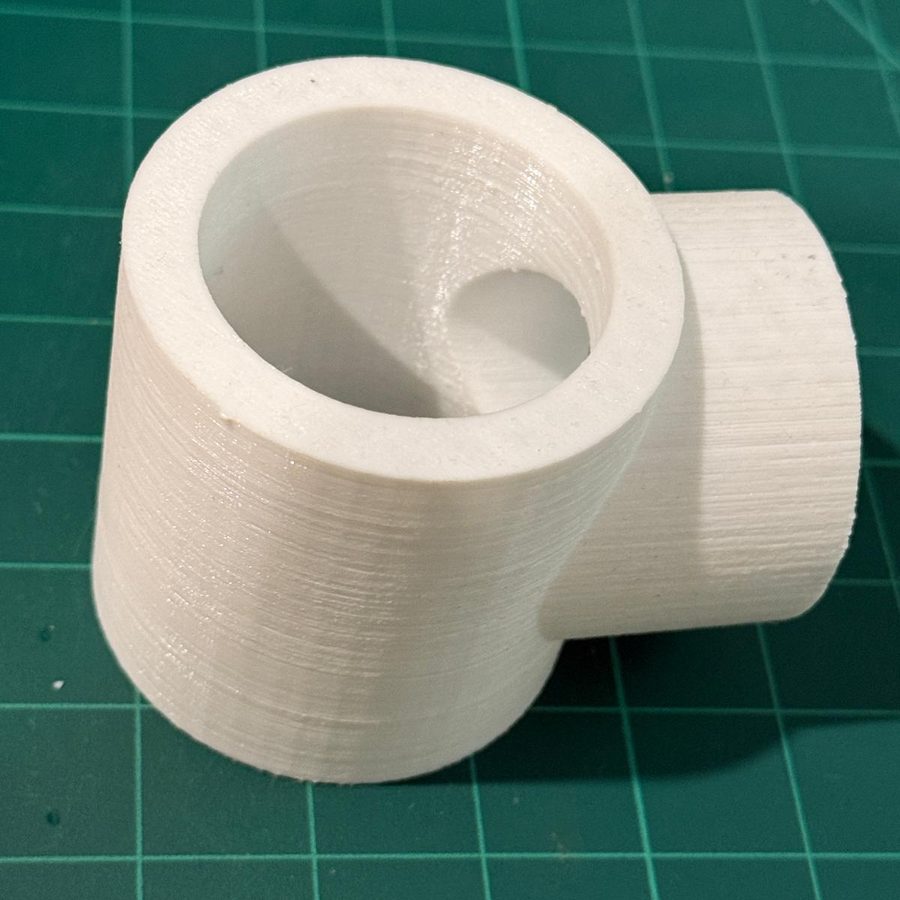
A customer had designed a motor housing for a robot build and had the STL ready, but their own printer kept failing partway through the long run the part needed. The job came here as a print-only job, was printed in a single run, and went back as a finished part.
The job in short
- ARRIVED ASAn STL supplied by the customer
- THE PROBLEMTheir machine failed halfway through the print
- WORKPrint only — the design was already theirs
- OUTPUTOne finished part, printed in a single run
Every detail on this page came from the job itself. Nothing here is inferred from the photograph.
The design was fine. The print was the problem.
This customer had done the hard part themselves. They had designed a motor housing for a robot build, they had a working STL, and there was nothing wrong with the model. What they did not have was a print. Their machine kept failing halfway through the run, and a housing like this one — a tall, hollow, single-piece cylinder with a boss on the side — is a long print. Failing halfway means losing hours of machine time and a good quantity of filament, and then doing it again.
The job that came here was therefore a narrow one, and worth naming plainly: print this, properly, once.
Why long prints fail and short ones do not
A print that takes twenty minutes rarely fails. A print that runs for many hours is a different proposition, because every small problem gets the whole duration to become a large one.
Filament has more time to catch, tangle or run out. A partial nozzle blockage that a short print would finish before noticing becomes a layer that does not bond. Bed adhesion that holds for an hour lets go in the fourth as the part cools and pulls at the corners. A tall part gets more slender relative to its base as it grows, so the same small knock that is nothing at layer ten can shear it off at layer four hundred. And every one of these failures costs the entire print, not the part of it that went wrong.
The difference between a machine that finishes long jobs and one that does not is rarely a dramatic one. It is a tuned first layer, filament that is dry and feeding cleanly, a bed that is genuinely level, and a machine that is watched. None of that is exotic. It is just the difference between equipment used occasionally and equipment used every day.
Print-only jobs are welcome, and your design stays yours
Not every job needs modelling, and a print-only job is not a lesser job here. If you have a file that is ready to go, send it — that is the fastest and cheapest route to a part, and there is no obligation to buy design work you do not need.
Where a customer supplies the file, the design is theirs and stays theirs. Nothing supplied is reused, republished or printed for anyone else. See what happens to your files for how this works across every kind of job.
One thing does get done even on a print-only job: the file is checked before it goes on the machine. If something in the geometry is going to cause the print to fail, or would leave a part that is weak where it needs to be strong, you will hear about it beforehand. On this job the file was sound and it went straight on.
What this job shows
There is a real category of enquiry that is simply “my printer cannot do this one”, and it is a perfectly good reason to get in touch. A machine at home that handles most jobs will still baulk at the long ones, the tall ones and the ones that have to come out right the first time. Those are exactly the jobs worth sending out.
Got a part like this one?
Send a photo of the part, drawing or assembly with a rough size, and tell us the machine or assembly it's for. Minimum order $75.
Email a photo for a quoteOther jobs from the workshop
An industrial mount, refined prototype by prototype
An ongoing job for an industrial client: a mount refined across many printed prototypes, with more still to come. How iterative prototyping works here.
Scaling up a cycloidal gearbox for a robot arm
A robot arm builder sent an STL and asked for a bigger gearbox. Two full sets printed, with the front flange measured and re-derived by hand.