Home / Work / Industrial mount
An industrial mount, refined prototype by prototype
Case study — ongoing, iterative prototyping
An industrial client is developing a mount, and it is being refined through printed prototypes rather than designed once and committed. Many versions have been printed so far and more are expected. This is the longest-running job on the site, and the one that best describes how development work is handled here.
The job in short
- CLIENTIndustrial
- WORKPrototyping a mount
- PRINTEDMany versions so far
- STATUSOngoing — more prototypes expected
Every detail on this page came from the job itself. Nothing here is inferred from the photograph.
The plainest part on the site, and the most interesting job
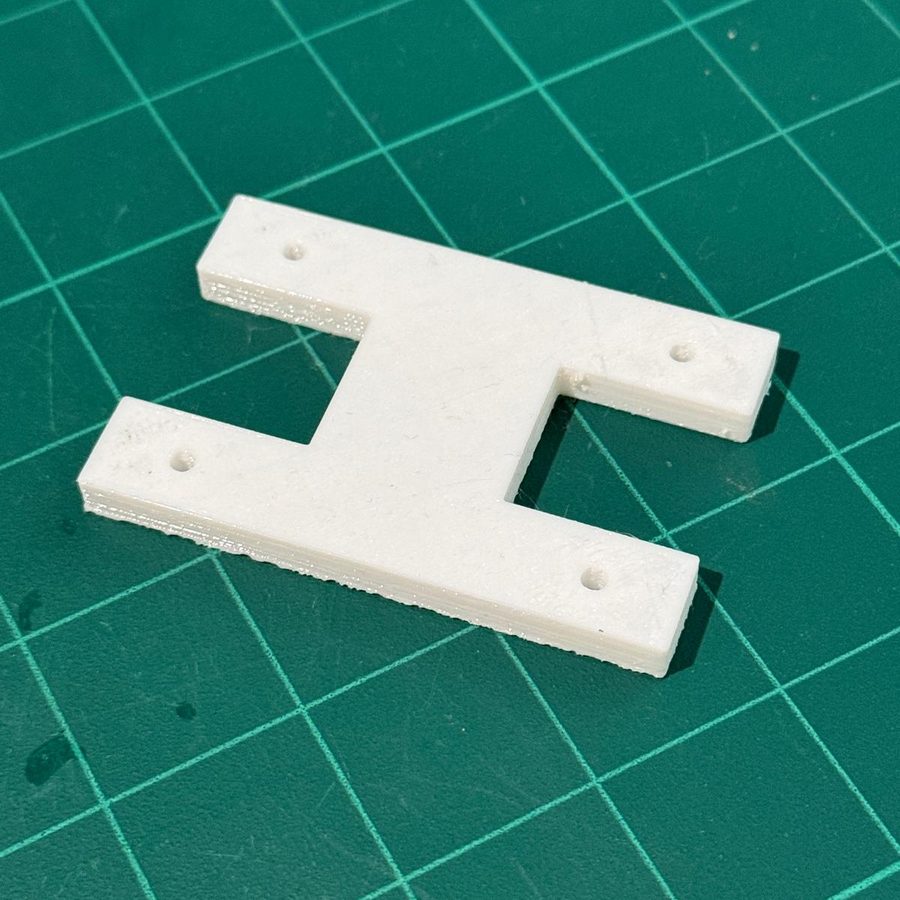
The photograph shows a flat H-shaped plate with four fixing holes. Next to a gearbox housing or a planetary gear set it looks like nothing at all — and it is the job on this site that says the most about how the work actually runs.
It is one prototype of a mount being developed for an industrial client. It is not the first version and it will not be the last. Many have been printed already and more are expected, because the design is being arrived at rather than handed over.
Why a mount takes more than one attempt
A mount has to reconcile things that were never designed to go together. It has to hold whatever it holds in the right position and orientation, bolt to a structure whose fixing points already exist and cannot move, clear everything else in the vicinity, be reachable with a tool by someone installing it, and stay stiff enough under load that the thing it is mounting does not shift.
Every one of those constraints is straightforward on its own. The difficulty is that they are only fully known once a physical version exists in the actual space. A model can be checked against a drawing; it cannot tell you that a spanner will not reach the rear bolt, or that a bracket that is stiff enough in theory rings under vibration in practice. Those things are found by holding the part, offering it up, and seeing what is wrong with it.
This is why a plain-looking part can take many iterations, and why the number of iterations is not a sign that anything is going badly. It is the process working.
What makes iteration affordable
The reason this approach is practical at all is that a printed prototype is cheap and fast. There is no tooling to pay for and no minimum quantity, so a revision costs a few hours and some filament rather than a change order. That changes the economics of being wrong: when a wrong version costs very little, you can afford to find out early and often, and the design converges on something that works instead of something that was defensible on paper.
It also changes the conversation. A client holding version four can point at exactly what is not right in a way that nobody can do while looking at a screen, and the next version can be on the printer the same week.
How ongoing work is handled
Development jobs like this one are treated as a continuing relationship rather than a series of unrelated orders. The model is kept and versioned between rounds, so a revision starts from where the last one finished instead of being rebuilt. Prints stay consistent between versions — same material and same settings unless there is a reason to change one — so that when a prototype behaves differently, the design is the reason and not the printing. And what changed between versions is recorded, because on the ninth revision nobody reliably remembers what the fourth one was for.
This is the kind of work Partsmith is set up for: a business with a real engineering problem, a budget for solving it properly, and a need that recurs. It is a better use of one workshop and one printer than a large number of one-off orders, and it is why the site is written for businesses rather than for everyone.
What this job shows
That the most valuable jobs are not the most impressive-looking ones. An H-shaped plate with four holes is the least photogenic part in the gallery, and it represents the longest relationship, the most printing, and the clearest example of what a client actually gets: not one part, but a design that arrives at being right.
Got a part like this one?
Send a photo of the part, drawing or assembly with a rough size, and tell us the machine or assembly it's for. Minimum order $75.
Email a photo for a quoteOther jobs from the workshop
Scaling up a cycloidal gearbox for a robot arm
A robot arm builder sent an STL and asked for a bigger gearbox. Two full sets printed, with the front flange measured and re-derived by hand.
A print-in-place planetary gear set for a university robotics project
A university robotics project sent an STL with no running clearance between the gear teeth. Adjusted, printed at 0.1 mm and tested twice before delivery.