Home / Work / Planetary gear set
A print-in-place planetary gear set for a university robotics project
Case study — supplied STL, corrected and tested
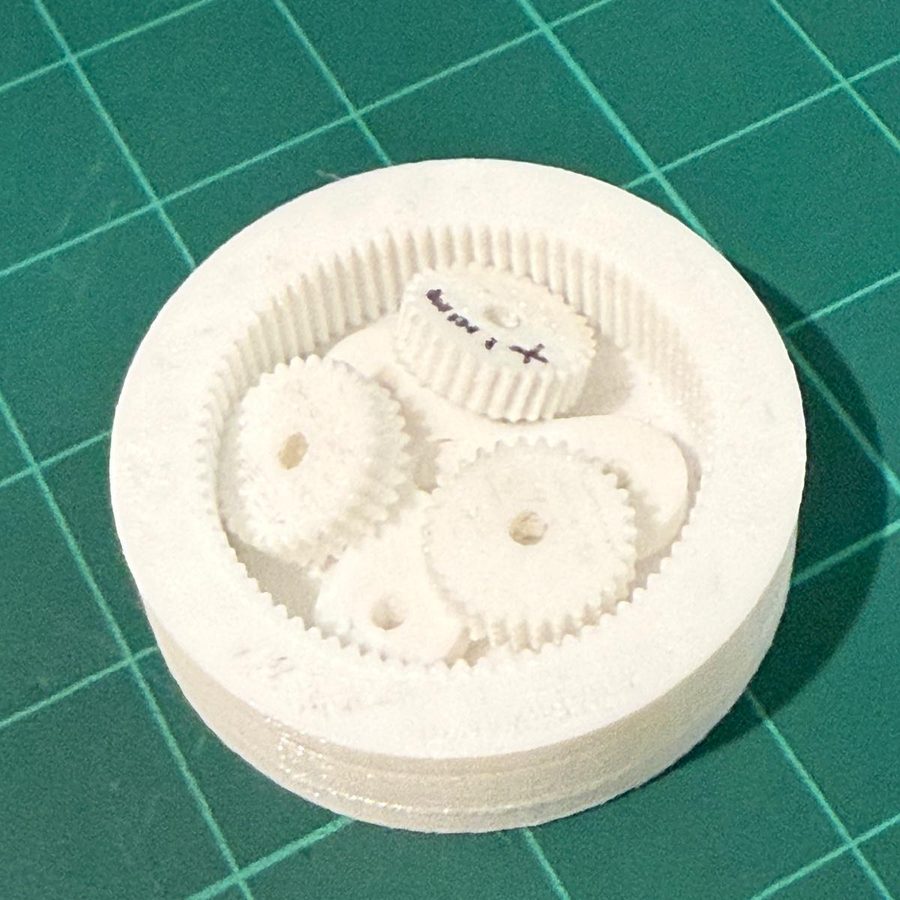
A university student sent an STL for a print-in-place planetary gear set to be printed for a robotics project. The design had not allowed running clearance between the meshing gears, so a small adjustment was made to the gear diameter, and the set was printed and tested twice before it was handed over.
The job in short
- ARRIVED ASAn STL supplied by the customer
- LAYER HEIGHT0.1 mm
- INFILL20%
- PRINTEDTwice, tested both times
Every detail on this page came from the job itself. Nothing here is inferred from the photograph.
Print-in-place, and why it is less forgiving than it looks
A print-in-place mechanism comes off the bed already assembled. Nothing is glued, pressed or bolted together afterwards — the ring gear, the three planet gears and the central sun gear in the photograph were printed as one job, in one piece, and were turning the moment the part was lifted off the plate.
It is a genuinely satisfying thing to hand someone, and it is also the least forgiving thing to print. Every other assembly gives you a chance to correct at the end: if two parts are tight, you can sand one back. A print-in-place mechanism has no assembly stage, so there is nowhere to fix anything. Whatever gap the model specifies between the gear teeth is the gap you get, and if that gap is wrong the whole thing comes off the plate as a single fused lump.
What was wrong with the file
The set had been designed by the customer, a university student, for a robotics project, and the design had not accounted for running clearance between the meshing gears. That is an entirely ordinary thing to miss, and it is worth explaining why rather than just noting it.
In CAD, two gears meshing at their theoretical pitch is correct — that is how the geometry is defined and how it is meant to be drawn. In a printed part it is not, because extruded plastic does not land exactly on the line it was told to. Each surface sits a fraction proud of where the model puts it, and two surfaces modelled as touching will meet, weld and stay welded. This is one of the most common reasons a first print of someone else's file fails, and it has nothing to do with the design being bad.
The fix, and why it was a small one
The correction was a small adjustment to the gear diameter — enough to open a running gap between the teeth without changing how the gear train behaves. Deliberately backing the geometry off so that the printed result lands where the design intended is a normal part of preparing a file for FDM, and making the change on the diameter kept the gear ratios and the tooth profile intact.
It is worth being plain about why no figure appears here. The right amount of clearance depends on the material, the nozzle, the layer height, the print speed and the geometry itself, and a number quoted outside that context is a number that will let someone down. The reliable method is to print it and check it, which is what happened.
Printed at 0.1 mm, tested twice
The set was printed at a 0.1 mm layer height with 20% infill. The fine layer height was the whole point: on a gear tooth, layer height is what decides how closely the printed flank follows the curve it is supposed to be, and a coarser setting turns a smooth profile into a visible staircase that meshes roughly and wears quickly. It prints slower. On this part it was worth it.
The set went through the printer twice, and was tested both times, before it went to the customer. Testing a print-in-place mechanism is refreshingly direct: turn it. If the sun gear drives the planets and the planets walk around the ring without binding or skipping, the clearance is right. If it does not move, it does not go out.
What this job shows
A student project runs on a deadline and usually on the student's own money, and a failed print costs both. The value here was not the printing. It was catching a fault in the file before any plastic was committed, and then being willing to run the job a second time to be sure of it. A part that arrives working is worth more than a part that arrives quickly.
Got a part like this one?
Send a photo of the part, drawing or assembly with a rough size, and tell us the machine or assembly it's for. Minimum order $75.
Email a photo for a quoteOther jobs from the workshop
Modelling a small centrifugal pump that someone else could print
A customer wanted a small centrifugal pump they could print themselves. Modelled from scratch and prototyped, with printability as a design constraint.
A long print that kept failing on the customer's own machine
A customer's own design, a long print, and a machine that gave up halfway every time. Printed here in one run and delivered finished.